The Quantum Leap: How Computers Are Entering a New Dimension
Summary / TL;DR
Quantum computers represent a fundamentally new era of computation. Unlike classical computers that store information as bits (either 0 or 1), quantum computers use qubits. Thanks to the bizarre laws of quantum mechanics, a qubit can exist as a 0, a 1, or both simultaneously (a state called superposition). Furthermore, qubits can be linked together in a phenomenon called entanglement, where their fates are intertwined no matter the distance. This allows quantum computers to process a vast number of possibilities at once, giving them the potential to solve certain complex problems that are currently impossible for even the most powerful supercomputers. They won't replace your laptop, but they promise to revolutionize fields like medicine, materials science, finance, and cryptography.
The Wall We're About to Hit
For over half a century, humanity has been powered by a simple, relentless engine of progress: Moore's Law. The observation that the number of transistors on a microchip doubles roughly every two years has fueled the digital revolution, giving us everything from smartphones to supercomputers. But this engine is sputtering. We are approaching the physical limit of how small we can make a transistor. At the scale of individual atoms, the predictable, classical laws of physics begin to break down, and the strange, probabilistic rules of the quantum world take over.
For classical computers, this quantum weirdness is a bug—a wall. For a new type of machine, it's the core feature.
Welcome to the world of quantum computing, a paradigm shift so profound it’s less like building a faster chip and more like harnessing a new dimension. This isn't just about faster computers; it's about computing in a way that was previously confined to the realms of science fiction.
From Bits to Qubits: A New Language for Reality
To understand the quantum leap, we first need to appreciate the elegant simplicity of the classical bit. A bit is a switch. It can be either OFF (0) or ON (1). Every email, video, and application on your computer is ultimately a fantastically long sequence of these simple, definite states.
A quantum computer, however, uses a qubit.
Imagine a bit is a light switch. A qubit is a dimmer switch. It can be fully OFF (0), fully ON (1), or somewhere in between. This "in-between" state is called superposition. While in superposition, a qubit holds the probability of being a 0 and the probability of being a 1 simultaneously.
Analogy: The Spinning Coin. A classical bit is a coin lying on a table, either heads (1) or tails (0). A qubit is that same coin while it's spinning in the air. It's not heads or tails yet—it's a blend of both possibilities. Only when you stop it (measure it) does it land on a definite side.
This ability to exist in multiple states at once is where the power begins. Two classical bits can represent one of four possible combinations (00, 01, 10, 11). To work through them all, a computer must check each one sequentially. Two qubits, however, can represent all four of those combinations at the same time in a single quantum state.
With 300 qubits, a quantum computer could represent more possible states than there are atoms in the known universe. This is the source of "quantum parallelism."
Entanglement: Spooky Action at a Computational Distance
If superposition is the first superpower of a qubit, its second is even stranger: entanglement.
When two or more qubits are entangled, their fates become intrinsically linked. No matter how far apart they are—across a room or across a galaxy—the state of one instantly affects the other. If you measure one entangled qubit and find it's a "0," you instantly know its partner is a "1," and vice versa.
Albert Einstein famously called this "spooky action at a distance." In computing, this spooky connection is a powerful resource. It allows for intricate correlations between qubits, enabling complex algorithms where changing one input can have precisely coordinated effects on many others simultaneously.
// A classical representation of state
let bits = [0, 1]; // Can only be this one combination at a time

// A quantum representation (conceptual)
let qubits = new QuantumState("50% |00> + 50% |11>");
// This entangled state holds the possibilities of 00 and 11 at once.
// Measuring one qubit instantly determines the other.
The Quantum Promise: What Can We Do With It? So, what are these incredible machines actually for? Quantum computers will not be used to browse the internet faster or play video games. They are highly specialized tools designed to solve a specific class of problems: those involving mind-boggling complexity and optimization.
Here are the key areas poised for revolution:
Drug Discovery & Materials Science: A single caffeine molecule is too complex for even the world's best supercomputers to simulate perfectly. A quantum computer could simulate molecules with ease, allowing us to design new medicines, create revolutionary battery technologies, or invent new materials with unimaginable properties.
Financial Modeling & Optimization: Financial markets are a chaotic web of interconnected variables. Quantum computers could analyze these systems to create far more accurate risk models and optimize investment strategies on a scale that is currently impossible.
Breaking & Making Cryptography: The security that protects almost all digital information today relies on the fact that it's incredibly difficult for classical computers to factor large numbers. For a quantum computer running Shor's algorithm, it's trivial. This means quantum computers pose an existential threat to modern cybersecurity. The flip side? They also enable new, unhackable forms of communication through Quantum Key Distribution (QKD).
Artificial Intelligence: Certain machine learning algorithms could be dramatically accelerated, potentially leading to breakthroughs in AI by allowing for more complex and efficient data analysis and pattern recognition.
The Cold, Hard Reality of Building Them If quantum computers are so powerful, why don't we have them everywhere? Because building and operating them is one of the greatest engineering challenges in history.
The quantum states of superposition and entanglement are incredibly fragile. The slightest vibration, temperature change, or stray magnetic field can cause a qubit to "decohere"—to lose its quantum properties and collapse into a boring old classical bit, destroying the computation.
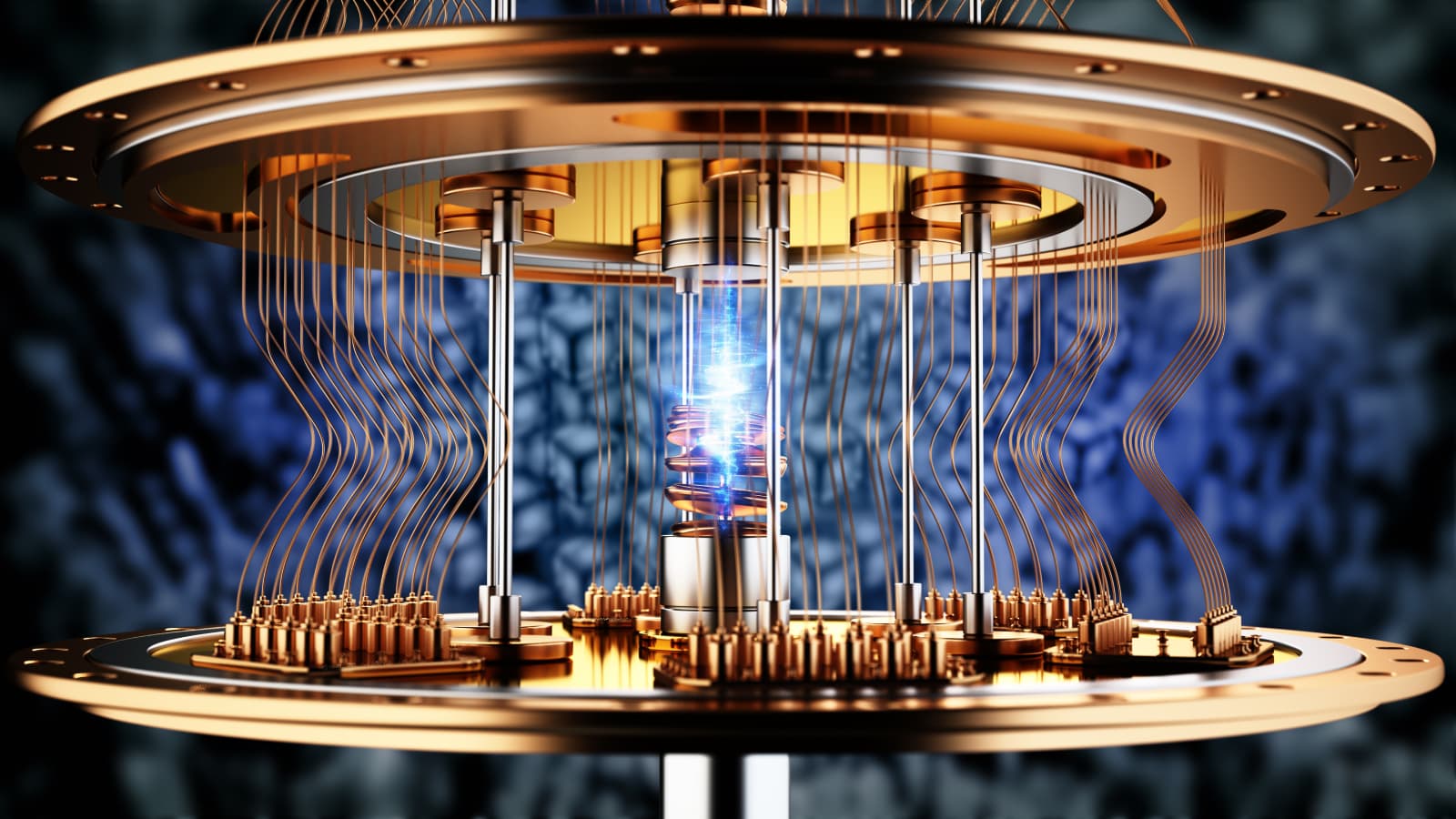
To prevent this, current quantum computers look like steampunk chandeliers housed in enormous, super-cooled cylinders. They are kept in a vacuum, shielded from the Earth's magnetic field, and cooled to temperatures colder than deep space (near absolute zero) to keep the qubits stable long enough to perform a calculation.
The Future Isn't Replaced, It's Augmented Don't throw away your MacBook just yet. The future is a hybrid one, where classical computers will handle our everyday tasks, and quantum computers will be accessed via the cloud as specialized co-processors. Scientists and engineers will send their hardest problems to a quantum computing service, which will perform its magic and send back the solution.
We are currently in the "Noisy Intermediate-Scale Quantum" (NISQ) era. Our machines are powerful enough to do things classical computers can't, but they are also small and prone to errors from decoherence. The race is on to build larger, more stable, and "fault-tolerant" quantum computers.
We are at the very dawn of a new computational age. Just as the first classical computers in the 1940s gave little hint of the connected world we have today, we likely can't even imagine the full scope of what quantum computing will unlock. It is a leap into a new reality, one where the fundamental rules of the universe are not limitations, but tools.